Picture this: you’re on the highway, glancing down at your Cadillac Lyriq’s range estimator, and you’re 40 miles from home with 38 miles of charge left. Your palms tighten on the steering wheel. Sound familiar? Range anxiety is the invisible passenger that rides along with every EV driver — no matter how premium the vehicle.
The Cadillac Lyriq is one of General Motors’ most ambitious electric vehicles to date, blending a sculpted luxury exterior with a whisper-quiet interior and an impressive EPA-estimated range of up to 314 miles (RWD). It’s positioned not just as an EV, but as a statement — proof that going electric doesn’t mean compromising on refinement or performance.
But here’s a question many Lyriq owners and prospective buyers quietly wonder about: do the driving modes actually change how far you can go on a charge?
The short answer is yes — driving modes in the Cadillac Lyriq do affect battery usage and real-world range. While they don’t alter the physical size or capacity of the battery pack, they significantly influence how aggressively that energy is consumed. Depending on the mode you select and how you drive, you could see a range variation of anywhere from a modest 10% to a more noticeable 20% or more.
Understanding this relationship isn’t just an academic exercise. For daily commuters, it’s the difference between arriving home comfortably and white-knuckling the last few miles. For road trippers, it can mean fewer charging stops. And for performance enthusiasts, it helps set realistic expectations when Sport Mode or V-Mode is engaged. Let’s dig into the details.
Understanding Cadillac Lyriq Driving Modes
2.1 What Are Driving Modes in EVs?
Driving modes in electric vehicles are software-defined profiles that adjust the car’s behavior across multiple systems simultaneously. Think of them as preset “personalities” for the vehicle — each one tuning throttle response, steering weight, regenerative braking intensity, suspension dynamics (where available), and sometimes even climate control strategies.
Critically, a driving mode does not change the physical battery. Your Lyriq’s 102 kWh Ultium battery pack holds exactly the same amount of energy regardless of whether you’re in Tour Mode or Sport Mode. What changes is the rate and manner in which that energy is drawn down. A mode that demands rapid, powerful acceleration will deplete the pack faster. A mode tuned for steady, measured power delivery will stretch every kilowatt-hour further.
This distinction matters because it shifts the conversation from hardware to driver behavior and software intelligence — both of which are very much in your control.
2.2 Available Driving Modes in Cadillac Lyriq
The Cadillac Lyriq offers a thoughtfully curated set of driving modes accessible through its 33-inch curved OLED display:
- Tour Mode — The factory default. A balanced, everyday-optimized setting that prioritizes efficiency without sacrificing comfort.
- Sport Mode — A performance-forward profile that sharpens throttle response, increases steering weight, and prioritizes acceleration over efficiency.
- Snow/Ice Mode — A safety-first configuration that smooths out power delivery to minimize wheel slip on low-traction surfaces.
- My Mode — A fully customizable setting that lets drivers dial in their own preferences for throttle sensitivity, steering feel, and regenerative braking intensity.
- V-Mode — Exclusive to the Lyriq-V performance variant, this mode unleashes the vehicle’s full power output and is engineered for maximum performance rather than maximum range.
Each mode addresses a different driving priority. The question is: what does that mean for your battery?
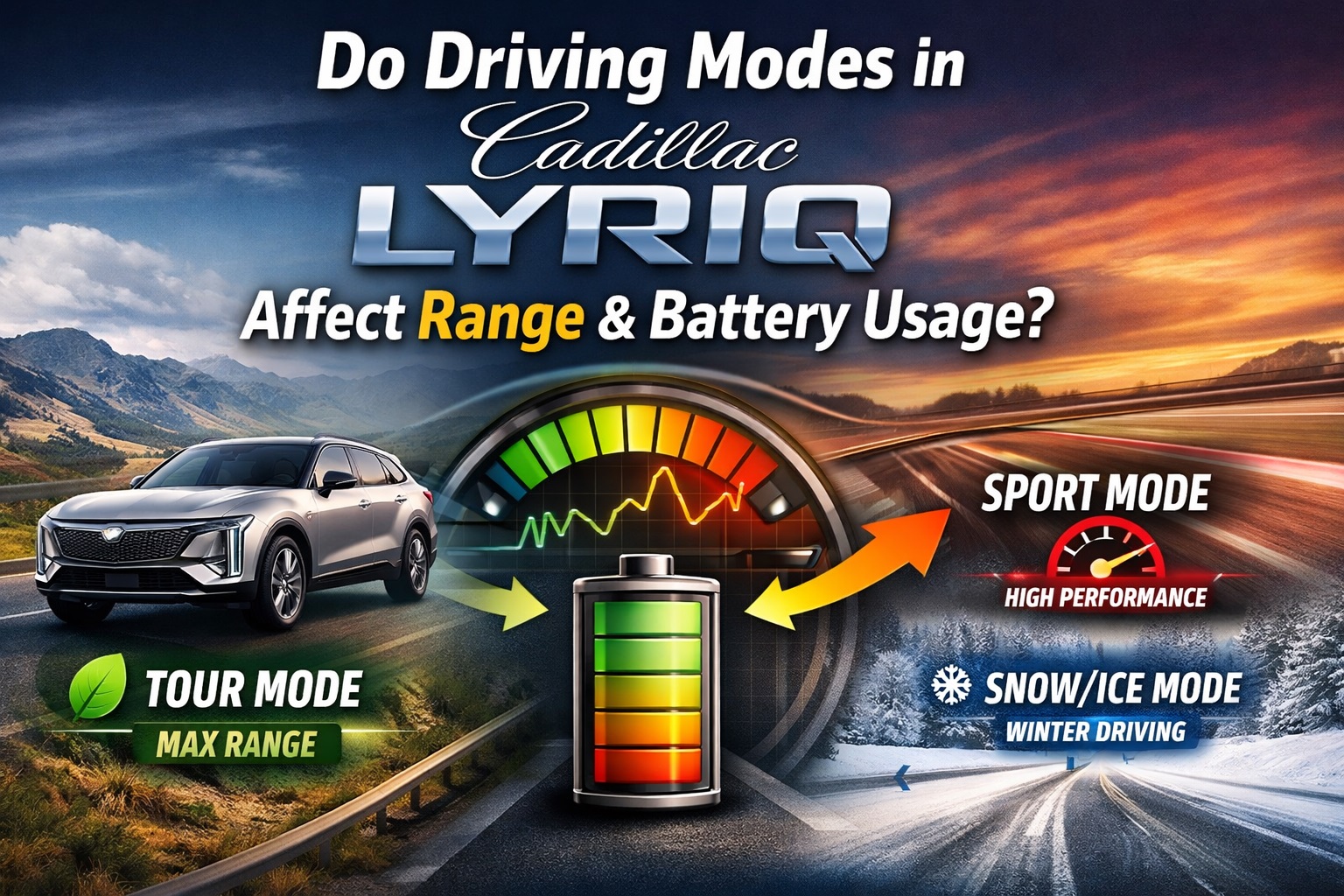
Do Driving Modes Really Affect Range and Battery Usage?
3.1 Short Answer Explained
Yes — and the effect is more meaningful than many drivers realize. Driving modes influence energy consumption by changing how the Lyriq’s motors, drivetrain, and ancillary systems respond to inputs. When more performance is demanded, more current is drawn from the battery. When the system is tuned for efficiency, it manages power delivery in ways that reduce total energy draw per mile.
The important nuance here is that mode selection interacts heavily with driving style. A disciplined driver in Sport Mode who avoids jackrabbit starts will lose far less range than an aggressive driver in Tour Mode who floors it at every green light. Mode sets the ceiling for performance — driver behavior determines how close to that ceiling you live.
3.2 Real-World Impact on Range
Based on typical EV behavior and owner-reported experiences, the range variation between the most efficient and least efficient modes can be approximately 10–20%, and in extreme cases even higher. For a vehicle with a 314-mile EPA range, that translates to a real-world difference of roughly 30–65+ miles between conservative and aggressive driving modes.
In practical terms, that’s a meaningful gap. Fifty extra miles of range can be the difference between making it to your destination comfortably and adding an unplanned charging stop to your journey.
How Each Driving Mode Impacts Range
4.1 Tour Mode — Best for Efficiency
Tour Mode is where the Lyriq shines as an everyday luxury EV. It strikes a carefully calibrated balance between responsive performance and intelligent energy management. Throttle inputs are processed smoothly, acceleration builds progressively rather than instantly, and the regenerative braking system is set to recapture a meaningful amount of energy during deceleration.
This is the mode that gets you closest to the EPA-rated range. For daily commuters, highway cruisers, and anyone on a longer trip who wants to arrive without charging anxiety, Tour Mode is your best friend. If you’re not sure which mode to use, start here and stay here.
Best for: Daily commuting, long highway trips, maximizing range.
4.2 Sport Mode — Performance Over Efficiency
Sport Mode transforms the Lyriq’s character noticeably. The throttle becomes far more responsive — a light press of the accelerator translates into a surge of forward motion that feels genuinely exciting in a 5,000-pound luxury SUV. Steering weight increases for a more planted, athletic feel, and the overall driving experience becomes viscerally engaging.
The trade-off is energy. That sharpened throttle response means the motors draw significantly more current, especially during acceleration. Drivers using Sport Mode regularly can expect a range reduction of roughly 10–25% compared to Tour Mode, though this varies considerably based on how aggressively the mode is used.
Think of Sport Mode as a treat — a Sunday drive mode, an on-ramp confidence booster, a way to remind yourself that yes, this quiet luxury SUV is genuinely quick. Just don’t expect it to be kind to your range estimator.
Best for: Spirited driving, on-ramps, when performance matters more than range.
4.3 Snow/Ice Mode — Safety Priority
Snow/Ice Mode is the responsible choice when weather conditions demand it. It deliberately softens power delivery, reducing the risk of wheelspin on slippery surfaces by limiting how quickly torque reaches the wheels. In AWD-equipped models, it also adjusts torque distribution to maximize traction stability.
From a pure range perspective, Snow/Ice Mode is a moderate trade-off. The smoother power delivery is actually somewhat efficient in isolation, but driving in cold weather — which is the very scenario this mode is designed for — significantly reduces battery capacity due to thermal limitations. Cold batteries simply can’t deliver or accept energy as efficiently as warm ones, which can cut real-world range by 20–40% regardless of which mode is active.
So while Snow/Ice Mode itself isn’t your biggest range enemy, the conditions that call for it certainly are.
Best for: Snowy roads, icy conditions, low-traction surfaces.
4.4 My Mode — Custom Settings
My Mode is arguably the most interesting option for informed drivers. It allows you to independently configure throttle sensitivity, steering weight, and regenerative braking intensity, then save that configuration as your personal driving profile. The result is a mode that is entirely as efficient — or as performance-oriented — as you choose to make it.
A driver who sets regenerative braking to its maximum setting, softens throttle response, and keeps steering in a light setting will effectively create a more efficiency-focused profile than even standard Tour Mode. Conversely, someone who maxes out throttle sensitivity will get Sport Mode–level consumption without the steering changes.
My Mode rewards knowledge and intentionality. The more you understand about how each setting affects energy use, the more finely you can tune your efficiency.
Best for: Drivers who want tailored performance and are willing to experiment.
4.5 V-Mode — Lyriq-V Only
V-Mode is the headline feature of the Lyriq-V performance variant, and it earns its reputation. When engaged, it activates the full 615 horsepower and 650 lb-ft of torque that the Lyriq-V’s dual-motor Ultium setup is capable of producing. The 0–60 mph time drops to around 3.7 seconds — territory that would embarrass many dedicated sports cars.
The battery consumption in V-Mode is the highest of any available setting. Full performance output from multiple electric motors is simply expensive in kilowatt-hours, and there’s no engineering magic that changes that equation. Owners using V-Mode frequently should plan their range expectations conservatively.
That said, V-Mode isn’t designed to be driven all day. It’s the Lyriq-V’s party trick — remarkable when you need it, best used with intention.
Best for: Track days, spirited canyon runs, performance demonstrations. Not for maximizing range.
Why Driving Modes Affect Battery Usage
Understanding the how behind mode-related range differences helps drivers make smarter decisions in real time.
5.1 Throttle Response and Power Delivery
The most direct driver of energy consumption is acceleration. Electric motors can deliver enormous torque instantaneously, and when a driving mode enables that full delivery on demand, the battery responds with corresponding current output. Simply put: faster acceleration equals higher instantaneous power draw equals faster battery depletion. Sport and V-Mode are configured to prioritize that responsiveness; Tour Mode deliberately moderates it.
5.2 Regenerative Braking Differences
Regenerative braking is one of an EV’s most powerful efficiency tools — and it behaves differently across modes. When the Lyriq decelerates, the electric motor acts as a generator, converting kinetic energy back into electrical energy stored in the battery. More aggressive regenerative braking recovers more energy per slowdown event.
Some modes apply stronger default regeneration, effectively giving the driver partial one-pedal driving capability. Others use lighter regen for a more traditional coasting feel. Over the course of a day’s driving, these differences add up to meaningful energy recovery disparities.
5.3 Climate Control and HVAC Adjustments
Some driving modes subtly adjust how aggressively the Lyriq manages climate-related energy use. Efficiency-oriented modes may pre-prioritize battery preconditioning and cabin temperature management to avoid large parasitic draws while driving. Performance modes may deprioritize these optimizations in favor of raw output. HVAC is one of an EV’s largest energy consumers outside of propulsion, so these adjustments matter.
5.4 AWD and Torque Distribution
In all-wheel-drive Lyriq configurations, driving modes influence how torque is split between the front and rear motors. Running both motors simultaneously draws more total energy than relying primarily on one. Efficiency-oriented modes tend to default to single-motor operation wherever possible, engaging the second motor only when traction or performance demands it. Performance modes keep both motors more actively engaged, which boosts acceleration but increases consumption.
EPA Range vs. Real-World Range
It’s worth clarifying an important distinction: the EPA range rating for the Cadillac Lyriq — up to 314 miles for the RWD single-motor model — is a standardized test result. It doesn’t change based on which driving mode you use. The EPA number is a fixed specification meant to allow apples-to-apples comparisons between vehicles.
Real-world range, on the other hand, is the figure that actually matters during daily use, and it shifts constantly based on:
- Driving mode selection — as detailed throughout this article.
- Driving style — how frequently and aggressively you accelerate.
- Speed — highway speeds above 65–70 mph increase aerodynamic drag significantly.
- Weather conditions — cold temperatures reduce battery efficiency; heat increases HVAC load.
- Terrain — climbing hills consumes energy; descending with regen partially recovers it.
The range estimator on the Lyriq’s display attempts to account for recent driving patterns and current conditions, but it’s a projection — not a guarantee. Treat it as a guide, not gospel.
Factors That Affect Range More Than Driving Modes
Driving modes matter, but they’re not the only — or even the largest — variable in real-world range. Experienced EV drivers often identify these factors as having equal or greater impact:
Speed: Aerodynamic drag increases with the square of velocity. Driving at 80 mph versus 65 mph is not a small difference in energy terms — it can cost 15–25% of range on its own.
Cold weather: Lithium-ion batteries lose efficiency in cold temperatures, and heating a cold cabin draws significant power. In sub-freezing conditions, real-world range can drop 20–40% compared to mild weather performance.
Air conditioning and heating: Running the HVAC system hard — especially electric resistance heating in winter — is one of the most significant non-propulsion draws on the battery.
Terrain: Consistent hill climbing drains range more rapidly than flat driving, even accounting for regenerative braking recovery on descents.
Tire pressure: Under-inflated tires increase rolling resistance. Keeping tires at the recommended pressure is a simple, free way to protect range.
Tips to Maximize Range in the Cadillac Lyriq
Getting the most from your Lyriq’s 102 kWh Ultium battery comes down to a combination of mode discipline and smart driving habits:
- Use Tour Mode for everyday driving and long trips. It’s the default for good reason. Tour Mode is optimized for balanced efficiency and is your best bet for approaching EPA-rated range.
- Avoid aggressive acceleration. Even in Tour Mode, heavy-footed driving is the fastest way to drain a battery. Smooth, measured inputs preserve range more than any other single behavior.
- Leverage regenerative braking. If your My Mode setup allows it, maximize regen settings for stop-and-go city driving. Each stop is an opportunity to recover energy rather than dissipate it as heat.
- Pre-condition the cabin while still plugged in. Before unplugging from a charger, use the Lyriq’s pre-conditioning feature to bring the cabin to your desired temperature. You’ll use grid power rather than battery power for that initial heating or cooling.
- Maintain steady highway speeds. Cruise control at a consistent 65 mph is dramatically more efficient than variable speed driving at 75–80 mph. On long highway stretches, this single habit can add 20+ miles of range.
- Monitor tire pressure regularly. The Lyriq’s tire pressure monitoring system will alert you to significant drops, but checking periodically — especially as temperatures change seasonally — ensures you’re not losing free range to rolling resistance.
Common Myths About Driving Modes
Myth: “Driving modes change how much energy the battery holds.” False. No software setting alters the physical capacity of the Lyriq’s 102 kWh Ultium pack. Modes change how quickly that energy is used, not how much of it exists.
Myth: “Sport Mode will always drastically cut your range.” This one depends heavily on driving style. A driver using Sport Mode on an open highway at steady speeds, enjoying the sharper steering feel without repeatedly flooring the accelerator, may see only a modest range reduction. It’s aggressive acceleration events — not the mode label itself — that cause the sharpest drops.
Myth: “The range estimator is always accurate.” The estimated range shown on the display is a real-time projection based on recent driving patterns and available battery data. It can shift significantly as conditions change — a cold front rolling in, a series of rapid accelerations, or a long uphill stretch can all cause the number to drop faster than expected. Always leave a buffer, especially in unfamiliar territory.
When to Use Each Mode — A Practical Guide
| Situation | Recommended Mode |
|---|---|
| Daily commute (city or highway) | Tour Mode |
| Long road trip | Tour Mode |
| Spirited weekend drive | Sport Mode |
| Snowy or icy roads | Snow/Ice Mode |
| Personalized experience | My Mode |
| Maximum performance (Lyriq-V only) | V-Mode |
This isn’t a rigid rulebook — real driving involves judgment calls. But this framework covers the majority of scenarios most Lyriq owners encounter, and following it will generally yield the best balance of performance, safety, and efficiency for each context.
Final Verdict
Driving modes in the Cadillac Lyriq do not change how large the battery is or how much energy it stores. That 102 kWh pack is constant across every mode. What modes do — meaningfully and measurably — is determine how quickly and aggressively that energy gets used.
Tour Mode delivers the longest real-world range by managing power delivery with efficiency in mind. Sport and V-Mode prioritize performance, and the battery drain reflects that. Snow/Ice Mode trades a modest efficiency penalty for the far more important benefit of traction and safety. My Mode puts the equation in your hands.
The takeaway for buyers and owners alike is this: choosing the right mode for the right situation is one of the most practical tools you have for managing range. It won’t replace good driving habits or thoughtful trip planning, but it’s a meaningful lever — and one that the Lyriq’s thoughtful engineering makes genuinely easy to use.
Frequently Asked Questions
Q: Do driving modes affect charging speed?
No. Driving modes are operational settings that control how the vehicle uses energy while driving. They have no effect on how quickly the Lyriq accepts charge from a Level 1, Level 2, or DC fast charger. Charging speed is governed by the onboard charger hardware and the charging equipment, not the active driving mode.
Q: Which mode gives the best mileage?
Tour Mode consistently delivers the best real-world range for most drivers. It’s designed to balance comfort and efficiency, and it provides the most favorable conditions for approaching the EPA-rated 314-mile figure (RWD). A carefully configured My Mode with maximum regenerative braking and softened throttle response could potentially match or approach Tour Mode efficiency.
Q: Can switching modes mid-drive save battery?
Yes — to a degree. Switching from Sport Mode back to Tour Mode mid-trip will immediately return the vehicle to its more efficiency-oriented power management. You won’t recover the energy already spent, but you can slow the depletion rate going forward. If you’re watching your range closely, switching back to Tour Mode early is a practical move.
Q: Is there an Eco Mode in the Lyriq?
The Cadillac Lyriq does not feature a dedicated “Eco Mode” in the traditional sense. However, Tour Mode functions as the efficiency-priority setting, filling the role that Eco Mode plays in many other EVs. Additionally, My Mode allows drivers to manually configure an efficiency-first profile by maximizing regenerative braking and softening throttle response — effectively creating a custom Eco Mode tailored to personal preference.
Hey Everyone! This is Mia Shannon from Taxes. I'm 28 years old a professional blogger and writer. I've been blogging and writing for 10 years. Here I talk about various topics such as Fashion, Beauty, Health & Fitness, Lifestyle, and Home Hacks, etc. Read my latest stories.