The Pulse Beneath Everything
“Everything in life follows a rhythm — from the beat of your heart to the tide of the sea.”
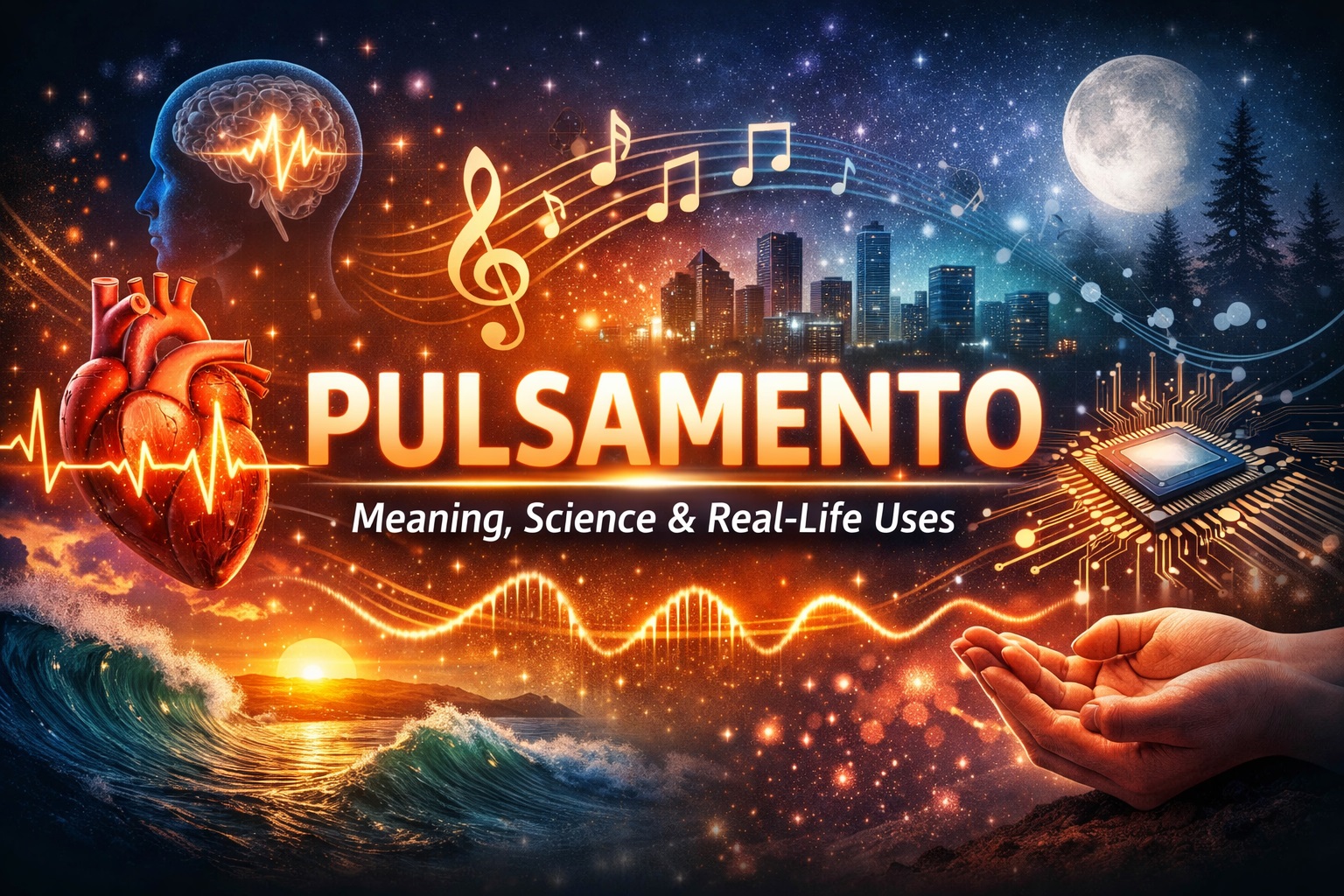
Beneath every heartbeat, every crashing wave, every musical phrase, and every blinking cursor on a screen, there is a rhythm — a recurring pulse that gives structure to what would otherwise be chaos. That pulse has a name: pulsamento.
It is not a buzzword born in a Silicon Valley boardroom, nor is it a trend from a wellness podcast. Pulsamento is one of the oldest and most fundamental ideas in human experience, threading through biology, physics, music, culture, and technology with quiet authority.
Today, as we grow more attuned to the systems that shape our lives — from circadian rhythms to user-experience design — this concept is gaining the serious attention it has always deserved. Its presence is unmistakable: in the human body, in the cycles of nature, in the structure of music, and in the timing engines of digital technology.
This article unpacks pulsamento from every angle: what it means, where it comes from, how science explains it, and — most importantly — how understanding it can improve your health, creativity, productivity, and sense of balance.
What Is Pulsamento?
At its most essential, pulsamento means a rhythmic pulse — a repeated vibration or flow of energy that recurs at regular (or near-regular) intervals. Think of it as the invisible skeleton that holds motion together: not the motion itself, but the structural template that gives motion its shape and predictability.
In scientific usage, pulsamento aligns closely with the concept of pulsation — a periodic fluctuation in a physical quantity, whether that is pressure, electrical signal, sound amplitude, or mechanical displacement. In everyday language, it carries a warmer meaning: the living sense of rhythm that animates everything from a jazz improvisation to the seasons.
Classic examples of pulsamento at work:
- The heartbeat — roughly 60–100 contractions per minute, sustaining life through rhythmic precision
- Ocean waves — driven by wind and gravity, arriving at shore in predictable pulses
- Sound vibrations — pressure waves in air that our ears decode as pitch and rhythm
The key takeaway: pulsamento is the structure behind motion and flow. It is not noise — it is pattern. Not chaos — but the framework that makes sense of change.
Origin and Etymology of Pulsamento
The word pulsamento descends from the Latin pulsare, meaning “to beat” or “to strike.” From this root, Italian and Spanish inherited the verb pulsare and pulsar respectively, both retaining the core sense of rhythmic striking or throbbing.
In its earliest formal uses, pulsamento referred to the physical act of striking a string or surface — particularly in the context of lute and guitar technique in Renaissance and Baroque music, where the manner of plucking (pulsamento) was distinguished from the manner of bowing or blowing.
Over centuries, the word’s meaning expanded. The physical pulse became a metaphor for energy, vitality, and ambience. By the modern era, pulsamento had evolved beyond music to describe the felt rhythm of any system — a city’s pulsamento, a team’s pulsamento, the pulsamento of a creative workflow. The literal became the literary; the mechanical became the metaphysical.
The Science Behind Pulsamento
4.1 Pulsamento in Biology
Biology is, at its core, a science of rhythms. Every living organism maintains its functions through precisely timed oscillations — and pulsamento is the umbrella concept that names this universal truth.
Heartbeat and Blood Circulation
The heart’s sinoatrial node fires electrical impulses at a rate calibrated to the body’s demands, driving blood through roughly 60,000 miles of vessels in a closed-loop rhythm. Disruptions to this pulsamento — arrhythmias — are among the most serious medical conditions known, underscoring how dependent life is on rhythmic regularity.
Breathing Cycles
Respiration follows a distinct pulsamento: inhalation, brief pause, exhalation, brief pause. At rest, most adults complete 12–20 cycles per minute. Yogic and meditative traditions have long recognized that consciously slowing and regularizing this pulsamento can calm the nervous system and reduce stress hormones.
Brain Wave Patterns
The brain generates measurable electrical rhythms — delta waves during deep sleep, theta waves in light sleep and meditation, alpha waves during relaxed wakefulness, and beta waves during active thought. Each state has its own characteristic pulsamento, and therapies such as neurofeedback aim to train the brain toward healthier rhythmic profiles.
In health monitoring, detecting anomalies in biological pulsamento is the foundation of diagnostics: the electrocardiogram (ECG), electroencephalogram (EEG), and pulse oximeter all work by measuring and interpreting rhythmic biological signals.
4.2 Pulsamento in Physics & Natural Systems
Physics teaches that oscillation — periodic back-and-forth motion around an equilibrium — is one of the most fundamental behaviors in the universe. From subatomic particles to galactic structures, pulsamento is built into the fabric of physical reality.
Waves, Oscillations, and Vibrations
A mechanical wave is nothing but a disturbance propagating through a medium in pulses. Sound waves, water waves, seismic waves — all are expressions of pulsamento. Even light, in quantum field theory, arises from oscillating electromagnetic fields.
Natural Cycles
- Day and night — Earth’s rotation creates a 24-hour pulsamento that synchronizes nearly all life on the planet
- Seasons — the axial tilt of Earth produces a yearly cycle that governs agriculture, animal behavior, and human culture
- Tides — the gravitational interplay of Earth, Moon, and Sun creates tidal pulses that have shaped coastlines and guided mariners for millennia
These large-scale natural pulsamentos reveal a deeper truth: stability and order in complex systems often emerge not from static conditions, but from the reliable repetition of dynamic cycles. Pulsamento is, in this sense, nature’s management system.
Pulsamento in Music and Sound
5.1 Role in Music
If you strip away the melody, the harmony, and the lyrics of any piece of music, you are left with pulsamento — the underlying heartbeat that every other element rests upon. It is the felt sense of forward motion, the internal clock that allows a roomful of musicians to play together without a conductor waving a baton.
Pulsamento in music is what makes you tap your foot, nod your head, or feel an almost involuntary compulsion to move. It operates below the level of conscious analysis; it is sensed rather than counted.
5.2 Pulsamento vs Tempo vs Beat
These three terms are often used interchangeably but refer to distinct phenomena:
- Pulsamento — the underlying sense of flow; the felt rhythm; the organism-level experience of musical time
- Tempo — the speed of the pulsamento, measured in beats per minute (BPM); a quantity that can be set with a metronome
- Beat — the discrete, countable unit within the tempo; the subdivisions marked by a time signature
A piece of music can have a slow tempo (40 BPM) but an electrifying pulsamento if the rhythmic interplay between instruments creates tension and release. Conversely, a fast tempo can feel lifeless if the pulsamento is mechanical and uniform. Great musicians don’t just play the beats — they breathe life into the pulsamento.
Cultural and Artistic Significance
6.1 Language and Cultural Evolution
Across cultures, pulsamento-like concepts appear with remarkable consistency. The West African concept of polyrhythm — layering multiple distinct rhythms simultaneously — is a sophisticated manipulation of pulsamento. Indian classical music’s tala system is an elaborate science of rhythmic cycles. Japanese taiko drumming treats each beat as a physical, almost sacred act.
In language, the metaphorical use of pulse and rhythm to describe social and emotional phenomena reflects an intuitive understanding that human collectives have their own pulsamento. We speak of a city’s “pulse,” a team’s “rhythm,” a conversation’s “flow” — all of which invoke the same core concept.
6.2 Symbolism in Art & Literature
In literature, pulsamento manifests as narrative rhythm: the pacing of scenes, the cadence of sentences, the alternation of tension and relief. Skilled authors do not merely tell stories — they orchestrate them, manipulating the reader’s sense of time through deliberate rhythmic control.
In visual art and design, pulsamento appears in the repetition of forms, the alternation of light and shadow, and the directed flow of a composition. A great painting has a visual pulsamento that guides the eye through the work. A well-designed interface has a temporal pulsamento — a sense of responsive flow — that makes interaction feel natural and satisfying.
Pulsamento in Technology
7.1 Digital Systems & Computing
Every digital device runs on pulsamento. The central processing unit (CPU) of a computer operates according to a clock cycle — a precisely timed electronic pulse that synchronizes all computational operations. A modern CPU might execute billions of these cycles per second (measured in gigahertz), with each cycle being a discrete pulse of electrical activity.
Data synchronization across networks, the timing of packet transmission, the refresh rate of a display — all are expressions of digital pulsamento. Without reliable rhythmic timing, digital communication would collapse into noise.
7.2 UX/UI and Product Design
In product design, pulsamento has moved beyond the purely technical into the experiential. Designers now speak explicitly about the rhythm of an interface: the timing of animations, the pace of transitions, the responsiveness of buttons. An app that responds too slowly or too quickly feels wrong — not because any individual element is broken, but because the pulsamento is off.
Loading animations, hover effects, scroll behavior, and micro-interactions all contribute to a product’s felt rhythm. The best digital experiences are characterized by a pulsamento that feels natural, effortless, and alive — creating the state that psychologist Mihaly Csikszentmihalyi called “flow.”
Psychological and Emotional Impact
8.1 Human Response to Rhythm
The human brain is a pattern-detection machine, and rhythm is one of the most primal patterns it seeks. From infancy, we are attuned to rhythmic stimuli: the heartbeat heard in utero, the rocking of a caregiver’s arms, the regularities of feeding and sleep. This early immersion in pulsamento shapes our neurological architecture.
Regular, predictable rhythms activate the brain’s reward circuitry, producing a sense of comfort and pleasure. Irregular or disrupted rhythms, by contrast, trigger alertness and mild anxiety — an adaptive response that primes us to investigate and respond to potential threats.
8.2 Mental Health & Well-being
The therapeutic power of rhythmic regularity is well-documented. Practices such as rhythmic breathing (including box breathing and 4-7-8 breathing), meditation, and rhythmic movement (yoga, walking, swimming) all work in part by imposing a calming, regular pulsamento on the nervous system.
Research in chronobiology has shown that irregular sleep-wake cycles — a disrupted circadian pulsamento — are strongly associated with depression, anxiety, and cognitive impairment. Re-establishing regular rhythms is a cornerstone of treatment for mood disorders and sleep pathologies.
Music therapy leverages pulsamento deliberately: rhythmic auditory stimulation (RAS) is used to help stroke patients retrain motor function, while drumming circles are used in trauma recovery programs. The rhythm provides a scaffolding onto which healing can be organized.
Real-Life Applications of Pulsamento
9.1 Daily Life
The most immediate domain of pulsamento in daily life is the sleep-wake cycle. The body’s circadian rhythm is a 24-hour internal clock that regulates alertness, metabolism, hormone secretion, and cellular repair. Honoring this pulsamento — sleeping and waking at consistent times, exposing oneself to natural light in the morning, avoiding blue light at night — is one of the highest-leverage interventions for overall health.
Beyond sleep, daily life is full of pulsamentos waiting to be recognized and optimized. Meals, exercise, rest, work, and social interaction all have natural rhythms. People who align their activities with their energy cycles — completing cognitively demanding work during peak alertness, resting during natural lulls — consistently report higher satisfaction and output.
9.2 Business & Workflow Systems
In business, pulsamento manifests in the cycles and cadences that govern organizational life. Sprint cycles in agile development, quarterly planning rhythms, weekly team syncs, daily stand-up meetings — these are all deliberate impositions of rhythmic structure onto complex work.
When business rhythms are well-calibrated, teams experience a sense of momentum and clarity: everyone knows when to push and when to review, when to create and when to evaluate. When rhythms are poorly designed — meetings too frequent, deadlines arbitrary, feedback cycles too long — organizations feel chaotic and exhausting, even if individual employees are talented and motivated.
The concept of the “meeting cadence” in modern management is essentially an acknowledgment that human collaboration has a pulsamento, and that getting it right matters as much as any strategic decision.
Benefits of Understanding Pulsamento
Grasping pulsamento as a unifying concept across domains offers practical benefits that span health, creativity, productivity, and emotional life:
- Improved creativity — Writers, musicians, and designers who understand pulsamento can modulate the rhythm of their work with intention, creating contrast, tension, and resolution that resonates with audiences at a felt level
- Better health awareness — Recognizing the role of biological pulsamento leads to more intelligent health habits: protecting sleep cycles, timing nutrition, using breathwork to regulate the nervous system
- Enhanced productivity and focus — Working with natural energy rhythms rather than against them — taking breaks at the right intervals, structuring deep work in focused pulses — produces more output with less depletion
- Stronger emotional balance — Understanding that emotions, like all rhythms, have their own ebb and flow reduces the anxiety of difficult emotional states; knowing that a trough follows a crest and vice versa brings equanimity
Common Misconceptions
As pulsamento enters wider usage, several misconceptions have emerged that dilute its meaning and utility:
“Pulsamento is just another word for rhythm”
Rhythm refers to the specific pattern of long and short durations — the arrangement of beats. Pulsamento is the underlying pulse from which rhythmic patterns are built. A rhythm varies and syncopates; pulsamento is the steady ground beneath that variation.
“Pulsamento is the same as tempo”
Tempo is the speed of the pulse, measurable in BPM. Pulsamento is the experienced quality of that pulse — its felt energy and life. Two pieces at 120 BPM can have radically different pulsamentos.
“It is just a musical term”
While pulsamento has musical roots, its application extends across biology, physics, psychology, technology, and culture. Restricting it to music misses its explanatory power as a unifying concept.
“It is a buzzword with no real meaning”
Used carelessly, any concept becomes a buzzword. But pulsamento has precise referents in every domain — the heartbeat in biology, the clock cycle in computing, the underlying beat in music — that give it genuine descriptive and analytical power when used with care.
Future Relevance of Pulsamento
As technology grows more intertwined with human biology and behavior, pulsamento is poised to become one of the key frameworks for understanding and optimizing the interface between people and systems.
Wearable Health Technology
Heart rate variability (HRV) monitors, continuous glucose sensors, sleep trackers, and smartwatches are all devices that measure biological pulsamentos in real time. As these technologies mature, they will enable increasingly personalized guidance — telling individuals not just what is happening in their bodies, but when to act, rest, eat, and engage based on live rhythmic data.
AI and Automation
Artificial intelligence systems that model human work patterns, optimize scheduling, and personalize digital experiences will increasingly rely on pulsamento-like models of human rhythm. AI coaches that learn when a user is in peak creative flow versus when they are depleted — and adjust demands accordingly — are an emerging category.
Digital Experiences
As screen-based interfaces face competition from ambient computing, voice, and spatial interfaces, the temporal dimension of user experience — its pulsamento — will become more important than layout or visual design. Products that feel alive and responsive will win; products with dead, mechanical timing will feel obsolete.
Conclusion
“To understand pulsamento is to understand that life, science, and creativity share a single underlying grammar — the grammar of rhythm.”
Pulsamento is not a metaphor borrowed from music and applied loosely elsewhere. It is a genuine structural feature of living systems, physical phenomena, and human experience. From the sinoatrial node firing in your chest to the clock cycle ticking inside your laptop; from the tidal rhythms of coastlines to the sprint cycles of software teams; from the breathing of a sleeping child to the narrative cadence of a great novel — pulsamento is everywhere, always.
Understanding it changes how you relate to your own body, your creative work, your relationships, and your environment. It reveals that what you thought were isolated facts — a healthy heart rate, an effective work schedule, a compelling design — are all expressions of the same deep principle: that systems thrive when they pulse.
The practical invitation is simple: pay attention to the rhythms around you and within you. Work with them rather than against them. Design them where you can. Restore them when they are lost. And recognize, in every pulse, the signature of something alive and ordered — the quiet grammar of pulsamento.
14 — Frequently Asked Questions
FAQs
Q1. What does pulsamento mean in simple terms?
Pulsamento is the rhythmic pulse or repeated vibration that gives structure to motion and flow. In everyday terms, it is the ‘heartbeat’ of any system — biological, musical, physical, or technological — that operates through regular, recurring cycles.
Q2. Is pulsamento a scientific concept?
Yes. While the word has literary and musical roots, it aligns precisely with scientific concepts such as oscillation, pulsation, and periodic fluctuation. It is measurable in biology (heartbeat, brain waves), physics (wave frequency), and technology (CPU clock cycles).
Q3. How is pulsamento used in music?
In music, pulsamento is the underlying felt beat — the sense of forward rhythmic motion that underpins melody, harmony, and tempo. It is distinct from tempo (the speed of the beat) and from rhythm (the pattern of long and short durations). Great musicians shape the pulsamento to create energy, tension, and emotional depth.
Q4. Why is pulsamento important in daily life?
Our bodies run on biological pulsamentos — sleep cycles, circadian rhythms, breathing rates, hormonal cycles. Understanding and honoring these rhythms improves sleep quality, energy management, cognitive performance, and emotional resilience. Disrupting them — through irregular sleep, poor timing of meals and exercise, or chronic stress — undermines health and well-being.
Q5. Can pulsamento improve productivity?
Yes, significantly. Research on ultradian rhythms suggests the human brain naturally cycles between high-focus and rest states roughly every 90 minutes. Working in structured, rhythmic pulses — intense focused periods followed by deliberate rest — aligns with this biological pulsamento and produces higher quality output with less fatigue than sustained, unbroken effort.
Hey Everyone! This is Mia Shannon from Taxes. I'm 28 years old a professional blogger and writer. I've been blogging and writing for 10 years. Here I talk about various topics such as Fashion, Beauty, Health & Fitness, Lifestyle, and Home Hacks, etc. Read my latest stories.